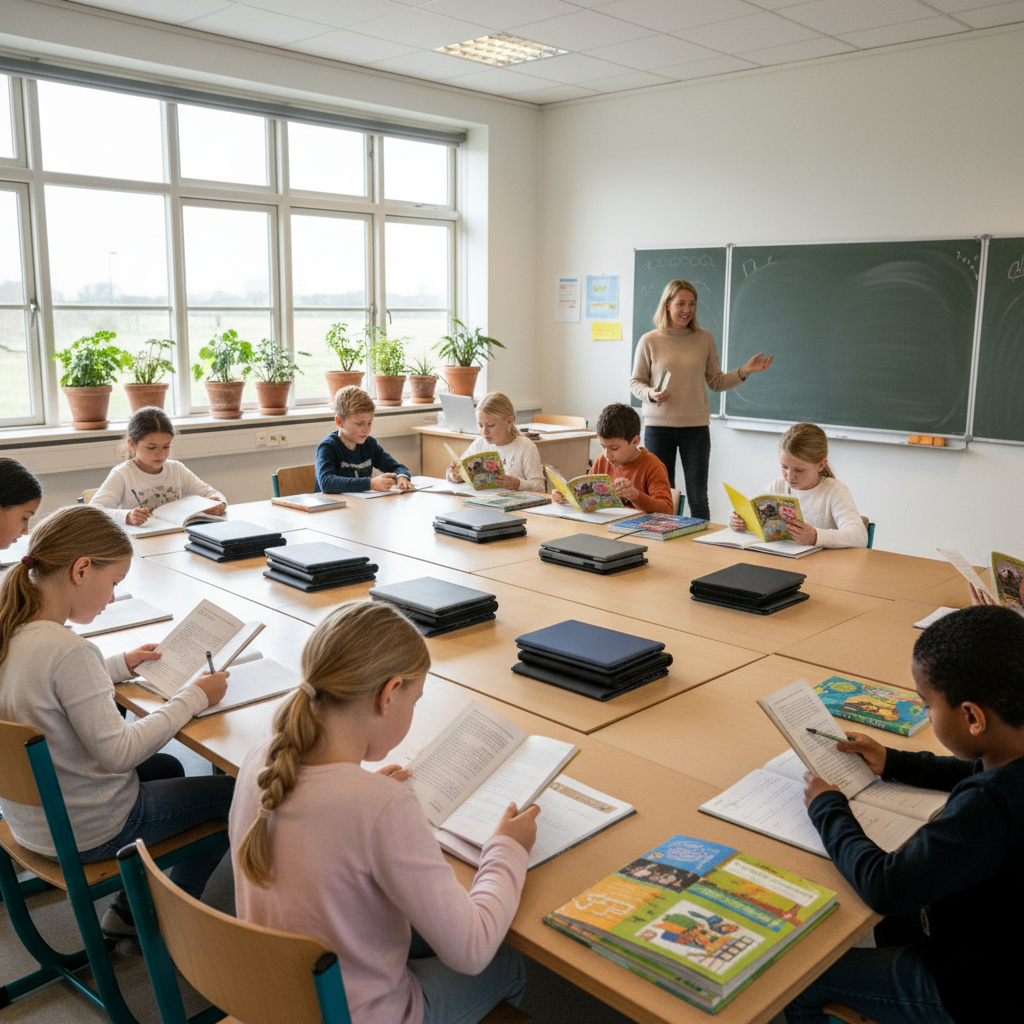
The real question is not which curriculum wins on paper. It is which one actually prepares children for life beyond school.
Parents often ask whether British, IB, US, or Australian education is better. They compare structure, academic strength, flexibility, and reputation.
But the more useful question is this: which system prepares children for the real world, not just exams? That is where the conversation becomes more revealing.
Many of the world's most respected school systems still produce students who are academically successful but not fully ready for work, uncertainty, or adult life.

The Global Reality
Across the world, employers continue to raise the same concern: academic achievement alone does not translate neatly into workplace readiness.
- Over half of employers report that graduates lack key workplace skills
- A large share of long-term job success depends on communication, adaptability, and interpersonal skills rather than academic knowledge alone
- Most school systems still optimise for exams, recall, and visible performance
That creates a serious mismatch between what schools reward and what life and work increasingly demand.
What the PISA Benchmark Tells Us
PISA is useful because it measures more than content recall. It looks at how well students apply learning to real-world problems.
Selected 2022 PISA-style comparisons place Australia, the UK, Denmark, and the US in a relatively similar average-high band, despite their very different educational philosophies.
- Australia: around 497
- UK: around 494
- Denmark: around 491
- USA: around 489
The striking insight is not who edges ahead. It is that the gap between systems is often smaller than the gap between what school teaches and what life requires.
What Different Curricula Really Produce
The surprising part is that these approaches can produce very different kinds of learners while still landing in similar academic performance ranges.
How That Translates to the Real World
The broad pattern is difficult to ignore. Systems that balance wellbeing, thinking, and communication tend to produce more adaptable humans, even if their academic performance looks similar on paper.
Is Australia Closer to Closing the Skills Gap?
Australia appears slightly closer than some systems because of its stronger emphasis on collaboration, problem-solving, and wellbeing. But the difference is not dramatic.
Its performance still sits in a similar band to the UK and the US. That tells us something important: even more balanced systems are not fully solving the skills gap yet.
The Deeper Issue
Across systems, the same pattern remains. Schools still prioritise content coverage, measurable outcomes, and visible performance more than they prioritise thinking, adaptability, and emotional regulation.
You can choose a strong curriculum, optimise for results, and still end up with a child who struggles with failure, avoids risk, or finds the real world overwhelming.
What Each System Can Learn From the Others
- The British system could learn from IB on inquiry and from Denmark on wellbeing
- Denmark could learn from the UK on academic stretch
- The US could learn from the UK on consistency and rigour
- Australia could learn from the UK and IB on deeper academic challenge
- IB could learn from more structured systems when clarity matters for particular learners
The Real Takeaway for Parents
The curriculum matters, but often not as much as parents think.
What matters just as much is how your child experiences learning within that system. The future rewards thinkers, communicators, and adaptable humans, not only high scorers.
A useful question for parents is this: is my child learning how to succeed in school, or how to succeed beyond it?