It starts innocently enough.
A tablet to keep them quiet on a long car journey. A phone so they can stay in touch with friends. A few YouTube videos before bed.
But behind the convenience, something much more serious is happening.
A growing body of research — from neuroscience, developmental psychology, and public health — is now painting a consistent and alarming picture of what smartphones and digital devices are really doing to children.
This is not about being anti-technology. It is about being honest about the evidence.
And the evidence says we have a problem.
1. Attention Is Being Rewired
The average child now switches between apps or content every 65 seconds.
That is not multitasking. That is attention fragmentation — and it is reshaping the developing brain.
The prefrontal cortex, which governs sustained focus, planning, and impulse control, does not fully mature until the mid-twenties. When children spend hours in rapid-switching digital environments, they are training their brains for distraction, not concentration.
Research from the National Institutes of Health found that children who spent more than two hours per day on screens scored lower on thinking and language tests. Brain imaging showed premature thinning of the cortex — the outer layer responsible for critical thinking.
This is not about willpower. It is about neurodevelopment. The brain adapts to the environment it is given. And the digital environment is training it to expect constant novelty and instant feedback — neither of which exist in a classroom, a book, or a meaningful conversation.
2. Dopamine Loops Are Driving Dependency
Every like, notification, and autoplay video triggers a small dopamine release in the brain.
This is not accidental. Social media platforms and apps are deliberately engineered to exploit the brain's reward system. Variable reinforcement — the same mechanism used in slot machines — keeps children scrolling, tapping, and checking.
Over time, the brain recalibrates. Natural rewards — learning something new, completing a task, having a face-to-face conversation — feel flat by comparison. The threshold for stimulation rises. Boredom becomes intolerable.
This is not addiction in the clinical sense for most children. But it is dependency. And it is making it harder for young people to engage with anything that does not deliver instant gratification.
What the research shows:
- Adolescents who use social media more than three hours per day have double the risk of anxiety and depression symptoms
- The dopamine response to screens mirrors patterns seen in early-stage behavioural addiction
- Children who are heavy screen users show reduced activity in the brain's reward centres when engaging in non-digital tasks
3. Anxiety and Mental Health Are Rising
The correlation between smartphone adoption and the rise in adolescent mental health problems is now one of the most documented trends in public health research.
Between 2010 and 2015 — the period when smartphone ownership among teenagers crossed 50 percent — rates of depression, anxiety, self-harm, and loneliness surged across every demographic.
This is not just correlation. Longitudinal studies — which track individuals over time — consistently show that increased screen time predicts worse mental health outcomes, even after controlling for other factors.
Jonathan Haidt's research, compiled in The Anxious Generation, identifies the combination of social media and smartphones as a primary driver of what he calls the "great rewiring of childhood."
Key findings:
- Girls are disproportionately affected, with social comparison and cyberbullying as key mechanisms
- Boys are more affected by displacement — losing time that would otherwise be spent on physical activity, socialising, and skill-building
- The effect is dose-dependent: more screen time correlates with worse outcomes, particularly beyond two hours per day
This is not a moral panic. It is a public health signal that we cannot afford to ignore.
4. Sleep Is Being Quietly Destroyed
Sleep is the single most important factor in a child's physical and cognitive development. And screens are systematically undermining it.
Blue light from screens suppresses melatonin production, delaying the onset of sleep. But the problem goes beyond light. The stimulating content — social media drama, gaming, endless scrolling — keeps the brain in a state of arousal that is incompatible with winding down.
Studies show that children who use devices in the hour before bed take longer to fall asleep, sleep less overall, and experience poorer sleep quality. The effects are cumulative. Over weeks and months, chronic sleep deprivation impairs memory, emotional regulation, immune function, and academic performance.
The numbers are stark:
- Over 70 percent of teenagers now sleep with their phone within arm's reach
- Adolescents who use screens before bed get an average of 30 to 60 minutes less sleep per night
- Sleep-deprived students perform measurably worse in every academic metric
A child who is not sleeping properly cannot learn properly. It is that simple.
5. Real-World Skills Are Declining
Every hour a child spends on a screen is an hour not spent doing something else.
This is known as displacement, and its effects are becoming increasingly visible. Children today spend significantly less time in unstructured outdoor play, face-to-face social interaction, physical activity, creative play, and independent problem-solving than any previous generation.
These are not optional extras. They are the foundational experiences through which children develop resilience, social skills, emotional regulation, physical coordination, and executive function.
What is being lost:
- Free play teaches negotiation, risk assessment, and conflict resolution — skills no app can replicate
- Face-to-face interaction builds empathy, reading body language, and emotional intelligence
- Physical activity supports brain development, mood regulation, and cardiovascular health
- Boredom — which screens eliminate — is a key driver of creativity and self-directed thinking
We are raising a generation that is digitally fluent but experientially impoverished. And the developmental consequences are only beginning to surface.
6. Academic Performance Is Being Impacted
Despite the promise that technology would transform education, the evidence tells a different story.
A landmark study by the OECD found that students in countries with the highest classroom technology use performed worse in reading, mathematics, and science than those in countries with moderate or low use.
The reason is not that technology is inherently bad for learning. It is that the way children use devices — constant switching, passive consumption, social media during study time — is fundamentally incompatible with deep learning.
What the evidence shows:
- Students who use laptops in lectures retain less information than those who take handwritten notes
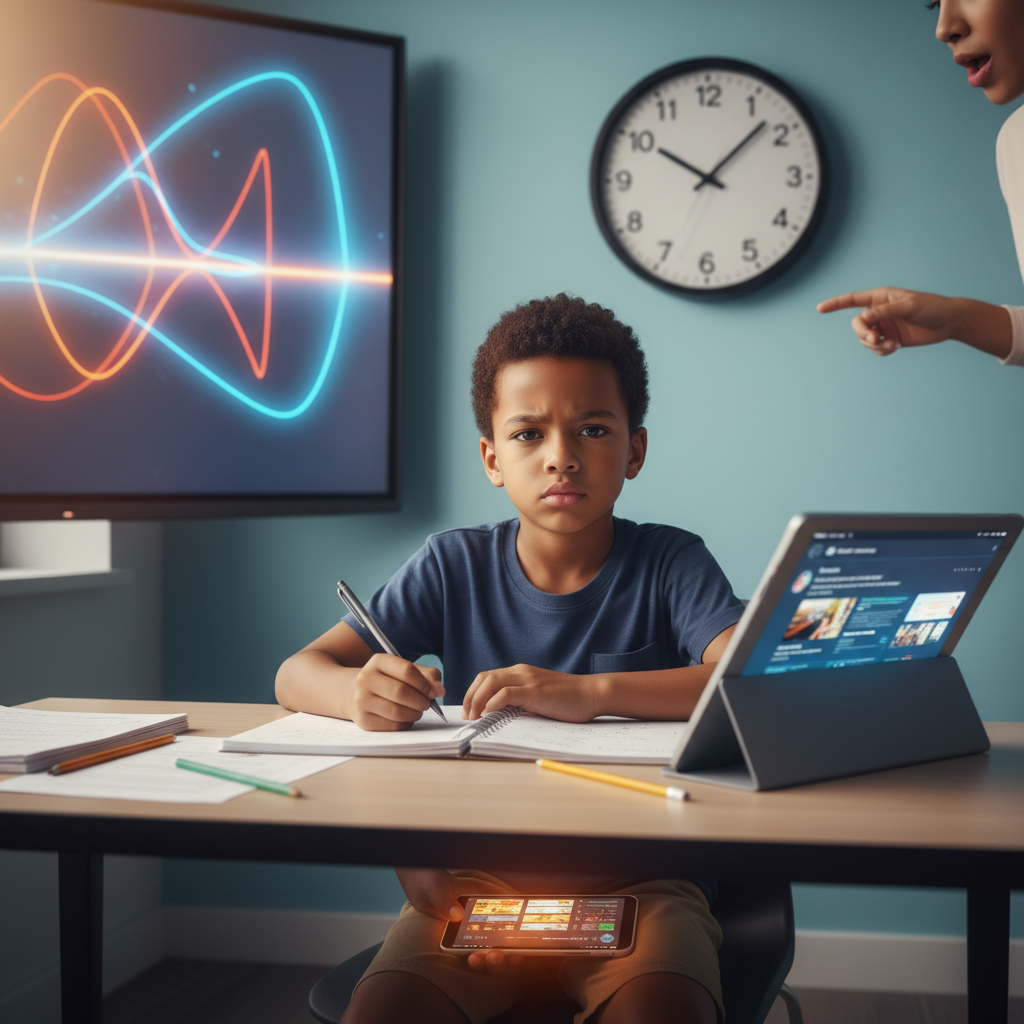
- The mere presence of a smartphone on a desk — even switched off — reduces cognitive capacity
- Multitasking with screens during study reduces comprehension by up to 40 percent
The schools that are getting the best results are not the ones with the most devices. They are the ones with the clearest boundaries around when and how technology is used.
7. The "Always On" Brain Has No Recovery Time
Perhaps the most underappreciated harm is this: smartphones have eliminated downtime.
Every spare moment — waiting for a bus, sitting in a car, lying in bed — is now filled with screen input. The brain never gets to idle.
And idling is not wasting time. Neuroscience shows that the brain's default mode network — which activates during rest and daydreaming — is essential for creativity, self-reflection, memory consolidation, and emotional processing.
When children never experience boredom, they lose access to the mental state that produces their most original thinking and deepest self-understanding.
This matters more than most people realise. The capacity to sit with your own thoughts, to process your day, to imagine and reflect — these are not luxuries. They are cognitive necessities.
And we are engineering them out of childhood.
This Is Not About Blame
If you have given your child a smartphone, you are not a bad parent. You made a reasonable decision based on social norms, practical needs, and incomplete information.
The problem is not individual parenting choices. The problem is structural.
Technology companies have spent billions engineering products designed to capture and hold attention — including the attention of children. Schools have adopted devices without fully understanding the trade-offs. And society has normalised a level of screen exposure that is historically unprecedented and developmentally untested.
This is a collective problem. And it requires collective action.
So What Can We Actually Do?
The good news is that the evidence also points clearly toward solutions. These are not extreme measures. They are practical, research-supported strategies that families and schools can implement now.
1. Delay smartphone access. Research increasingly supports delaying personal smartphone ownership until at least age 14, and social media access until 16. Several countries and school systems are now moving in this direction. The later children enter the smartphone ecosystem, the better their developmental outcomes.
2. Create screen-free zones and times. Bedrooms, mealtimes, and the hour before sleep should be device-free. These boundaries protect sleep, support family connection, and give the brain essential recovery time. Consistency matters more than perfection.
3. Protect sleep above all else. Devices should be charged outside the bedroom overnight. This single change has been shown to improve both sleep duration and quality. For adolescents, whose circadian rhythms are already shifting later, removing screens from the bedtime routine is one of the most impactful things a parent can do.
4. Reclaim unstructured time. Children need time that is not scheduled, supervised, or screen-mediated. Free play, outdoor exploration, and boredom are not problems to be solved — they are developmental necessities. Resist the urge to fill every gap with a device.
5. Schools must lead, not follow. The most effective schools are implementing phone-free policies, limiting device use to specific learning tasks, and teaching digital literacy as a core skill. Schools that remove phones from the school day consistently report improvements in behaviour, social interaction, and academic focus.
Final Thought
We are running an unprecedented experiment on an entire generation of children. The early results are not encouraging.
But this is not irreversible. The brain is remarkably plastic. Children who reduce screen time and re-engage with the physical, social, and imaginative world recover quickly.
The question is not whether we can afford to set limits.
It is whether we can afford not to.
The greatest gift we can give our children is not the latest device. It is the space to grow without one.