Modern Learning Crisis
The Collapse of Modern Education
How we lost attention, depth, and the ability to think slowly.
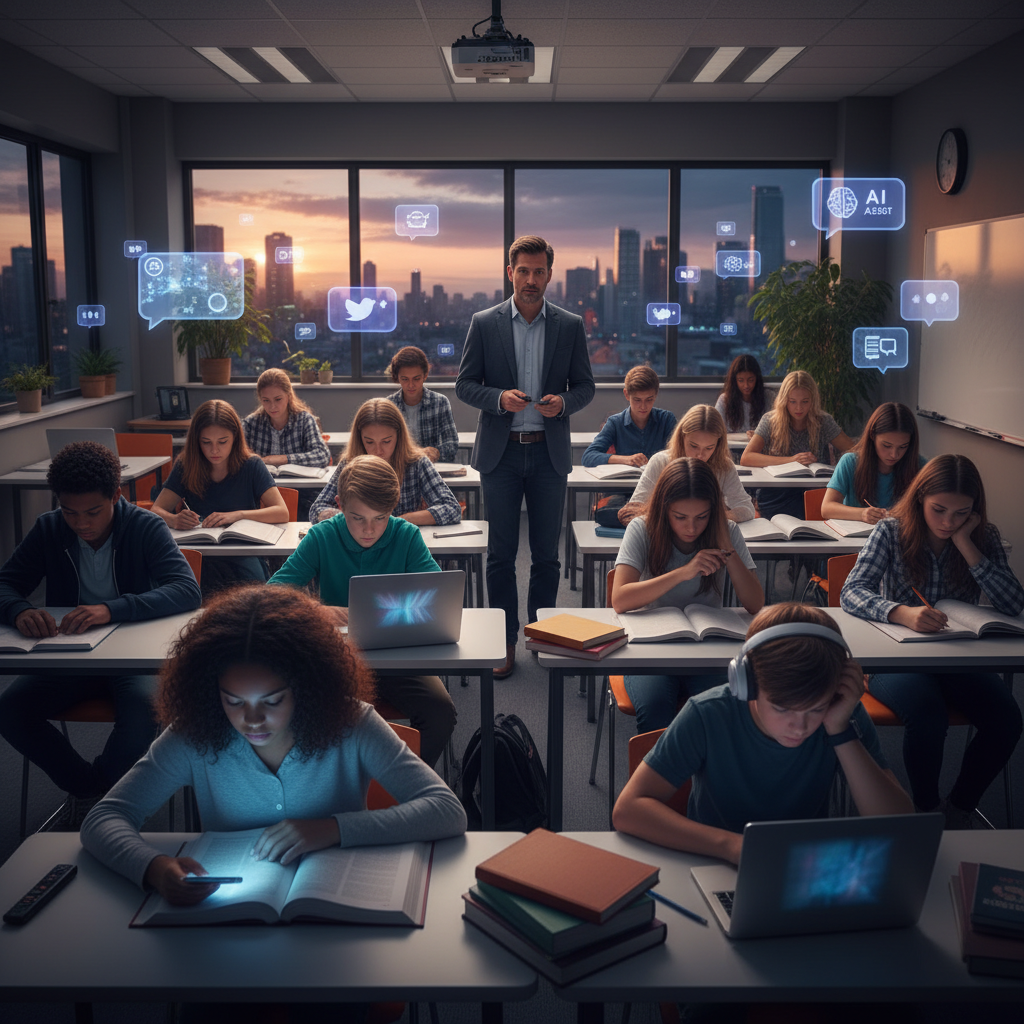
Something is breaking in education.
Not loudly. Not all at once. But across countries, classrooms, and age groups, the same signals keep appearing.
- Students struggle to focus.
- Reading depth is weakening.
- Anxiety is rising.
- Phones are being banned.
- AI is doing work that used to require thinking.
Individually, these look like separate problems. They are not. They are symptoms of the same shift.
We Did Not Just Change Education. We Changed the Brain It Depends On.
For decades, education relied on a simple assumption: that students could sit still, focus for extended periods, read deeply, tolerate effort, and stay with something long enough for it to become meaningful.
That assumption is becoming less reliable. Not because children are less intelligent, but because the environment shaping their attention has changed completely.
Modern schooling still requires slow thinking. Modern childhood increasingly trains fast switching.
The Death of Deep Reading
Start with something fundamental: reading. Not decoding words, but understanding them deeply enough to hold ideas, follow arguments, notice nuance, and build meaning over time.
The warning signs are already visible. OECD PISA 2022 reported unprecedented performance declines between 2018 and 2022, including a ten-point average fall in reading across OECD countries.
The pandemic was part of the story, but not the whole story. The deeper issue is that many students now approach text the way they approach the internet: scan, search, skip, summarise, move on.
This is not simple laziness. It is adaptation. We trained ourselves to consume information quickly, and now many students struggle to process it slowly.
When Attention Became a Commodity
Attention used to be a requirement for learning. Now it is a resource being competed for.
Students are no longer just sitting in classrooms. They are sitting inside an ecosystem of notifications, short-form content, infinite scrolling, algorithmic stimulation, social comparison, and instant answers.
Education is trying to operate inside that ecosystem. And it is losing ground.

So Schools Did What They Thought Made Sense
They adapted. Lessons became more visual, faster, more interactive, more broken into chunks, and more focused on immediate engagement.
On the surface, that looks like progress. But underneath, something more concerning can happen: education starts imitating the same systems that are fragmenting attention.
Education vs TikTok: A Fight It Cannot Win
Schools are now competing with platforms designed by behavioural scientists, data engineers, and attention economists. Their goal is not wisdom. Their goal is retention.
Real learning was never designed to win that fight because real learning is not optimised for frictionless engagement. It is slow. Effortful. Sometimes frustrating. Often boring before it becomes meaningful.
Those are precisely the conditions modern digital systems train children to avoid.
When Engagement Replaces Effort
Here is the shift no one wants to admit. We have started prioritising how learning feels over what learning requires.
Students are being trained to expect constant stimulation, immediate clarity, rapid feedback, and effortless understanding. When those are not present, many disengage.
Not because they cannot learn. Because they have not been trained to persist without stimulation.
The Smartphone Problem We Tried to Ignore
For years, schools tried to manage phones. Now many are restricting or banning them. That tells you something important.
A smartphone is not just a device. It is an interruption system. Every notification, vibration, glance, and mental check-in fractures attention. Over time, students do not just get distracted. They become distractible.
This is why governments are now stepping in. The UK government has issued guidance on prohibiting mobile phone use throughout the school day. UNESCO has also tracked the spread of phone restrictions and argued that smartphones should be used in school only when they clearly support learning outcomes.
That is not moral panic. It is recognition that the digital environment is not neutral.
The Mental Health Crisis No One Can Contain
At the same time, another trend is accelerating. Students are more anxious, more overwhelmed, and more mentally exhausted.
Again, this is not random. They are navigating academic pressure, constant comparison, information overload, online social exposure, and very little mental downtime.
OECD PISA 2022 also found a sharp rise in mathematics anxiety between 2012 and 2022 in most participating countries and economies. The academic and emotional issues are not separate. They feed each other.
When Learning Stops Feeling Sustainable
School used to be challenging. Now, for many students, it feels overwhelming. Not necessarily because standards have risen dramatically, but because the capacity to cope has been eroded.
Attention is weaker. Rest is limited. Stimulation is constant. Comparison is everywhere. So even normal academic demands can feel heavier than they used to.
The System Is Now Misaligned
Here is the core problem. We have students shaped by high-speed, high-stimulation environments being asked to function in systems that still require slow, sustained effort.
That gap is growing. And instead of addressing it, schools often patch it with quick fixes.
Quick fix
Make every lesson more entertaining
Hidden cost
Students become less tolerant of effort without stimulation
Real need
Rebuild attention, depth, resilience, and thinking capacity
And Now AI Has Entered the Chat
Just as attention declines, something else arrives: AI. A tool that can write, solve, explain, summarise, generate, and polish instantly.
Used well, AI can support learning. Used badly, it can remove the friction that learning depends on. UNESCO's guidance on generative AI in education frames this as a human-centred challenge, not just a technology issue.
The Final Shift: When Thinking Becomes Optional
This is where everything converges. If students already struggle with focus, deep reading, and sustained effort, and we introduce a tool that removes the need for all three, then we are not simply changing education.
We are redefining thinking itself.

This Is Not a Series of Problems. It Is One System Failing.
Connect it clearly:
- Declining reading reduces depth.
- Constant stimulation weakens attention.
- Engagement-first learning can reduce resilience.
- Smartphones fragment cognition.
- AI can outsource thinking.
- Rising anxiety reduces capacity.
This is not coincidence. It is a system under strain.
The Question No One Wants to Ask
We keep asking: what is wrong with students?
The harder question is: what kind of environment produces these outcomes?
Final Thought
We did not just digitise education. We changed how children think, focus, process, cope, and recover.
Now we are watching the consequences unfold in classrooms, mental health patterns, literacy data, phone policies, and assessment debates. Not because anyone intended harm, but because we moved too fast to ask what we were changing.
This Is Not the End. But It Is a Warning.
Education is not collapsing overnight. But it is being reshaped in ways we do not fully understand.
If we do not pause to question, rebalance, and rethink, we may not only lose academic standards. We may lose something more fundamental: the ability to think deeply, independently, and with focus.
The future of education will not be won by making learning faster. It will be won by protecting the capacity to think slowly.