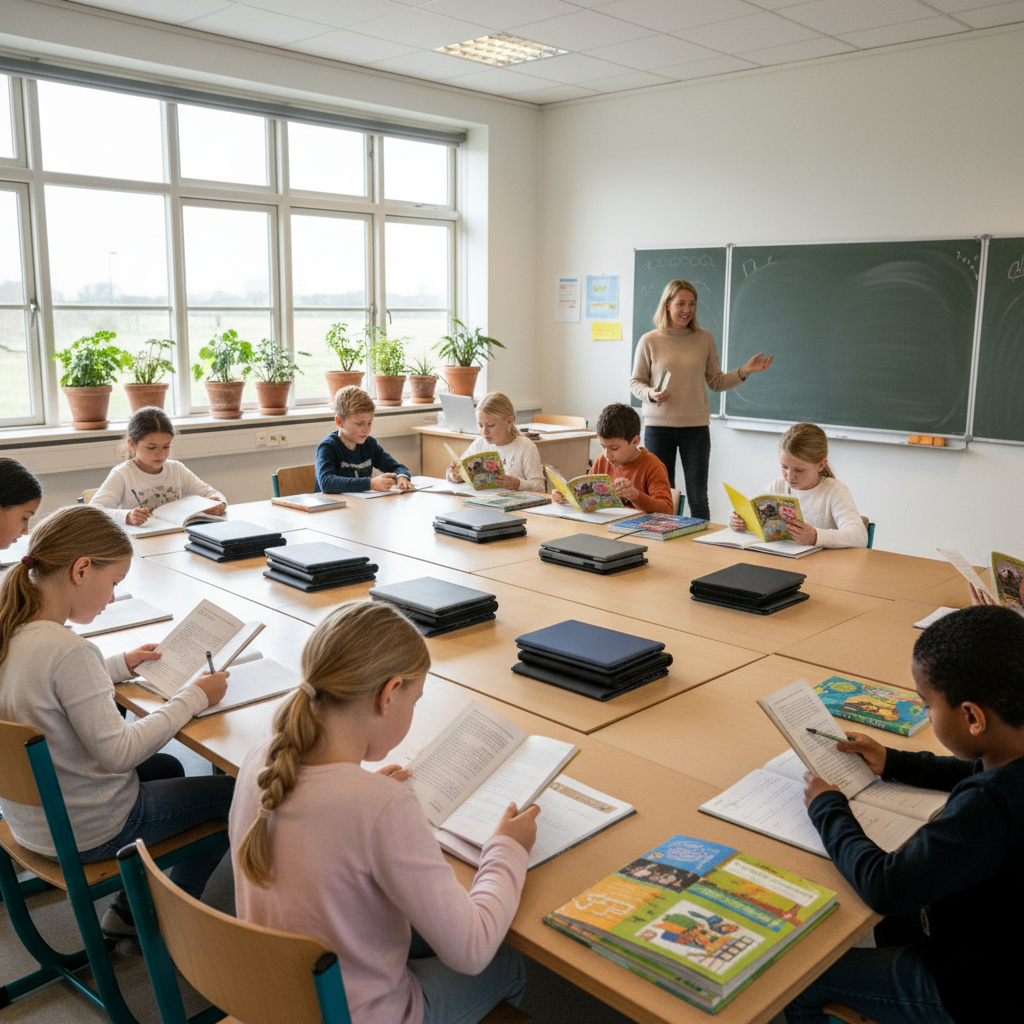
Global Education Business
Inside the Billion-Dollar Classroom
What happens when schools become investment assets, and why parents should understand the system behind the campus.

Education used to be spoken about primarily as a public good. Increasingly, it is also being treated as a global industry, and not a small one.
The language around schools has shifted. Campuses become assets. Families become customers. School groups become platforms. Expansion becomes a strategy. And investors are paying attention because education has something many sectors do not: long-term demand, recurring revenue, and parents willing to prioritise it even in uncertain economies.
The Scale Most People Do Not Realise
The broader global education market is often estimated in the trillions. BusinessDojo puts the total education market at about $7.3 trillion, with private K-12 education at roughly $431.5 billion in 2025 and private higher education at about $700 billion in 2024.
Those figures matter because they reveal the bigger picture. Schools are no longer just local institutions competing with other local institutions. In many markets, they are part of a large, investable, cross-border education economy.
The classroom has not stopped being a place of learning. But it is increasingly also part of a financial system.
The New Owners of Education
Behind many private and international school brands today are private equity firms, sovereign wealth funds, asset managers, and global investment groups. These are not traditional educators. They are capital allocators.
Recent sector reporting shows the direction clearly. Preqin reports that Spring Education Group announced $825 million in debt funding from Brookfield in June 2025. Regional reporting has also described private equity interest in Asia and the appeal of international schools because of steady tuition income and scalable platforms, including KKR-linked school-chain activity in Southeast Asia.
There are also platform-building strategies emerging in fast-growing markets. Reports around Blackstone's interest in building an Indian education platform have described plans in the hundreds of millions of dollars, including a proposed $600 million to $700 million platform strategy.

So What Changes Inside a School?
From the outside, very little may look different at first. The uniforms remain. The prospectus looks sharper. Facilities may improve. Marketing becomes more polished. But underneath, the logic of the institution can begin to shift.
1. Schools Become Scalable Systems
Investment-backed school groups are designed to grow. That often means replicable curriculum models, standardised teaching frameworks, shared technology systems, centralised procurement, and management decisions that can be applied across multiple campuses.
The goal is not only education. It is consistency. And consistency scales.
2. Performance Becomes Measurable and Comparable
In a traditional school, success may be described loosely through culture, reputation, relationships, or exam results. In an investment-backed system, success is more likely to be tracked through dashboards: student outcomes, enrolment, retention, parent satisfaction, staff utilisation, operational efficiency, and margin.
That is not automatically bad. Data can improve decision-making. But once everything becomes measurable, the system can start optimising for what is easiest to measure.
3. Parents Become Customers
When education is privately funded at scale, parents are not only parents. They are also paying clients. Schools compete for enrolment, marketing becomes central, and reputation management becomes part of the operating model.
That changes the relationship. Schools begin to behave more like service businesses, even when the work they do is far more personal and developmental than most services.
4. Expansion Becomes the Priority
Growth is not optional in many investment-backed models. It is expected. New campuses, new markets, new fee-paying segments, acquisitions, and brand extensions all become part of the story.
What investors see
Stable demand, recurring tuition, scalable campuses, premium positioning
What parents see
Facilities, results, brand, safety, opportunity, reputation
What can get missed
Depth, flexibility, belonging, teacher workload, child experience
The Upside, and Why Investors Are Interested
There are real reasons this model is growing. Demand for high-quality education is rising globally. Many families want international curricula, English-medium pathways, smaller classes, stronger facilities, and clearer routes into global universities.
For investors, that creates something rare: a stable, growing market with predictable demand. Parents may cut back elsewhere before they cut back on education. That makes schools attractive assets.
The Tension No One Can Ignore
Education is not a typical industry. It shapes thinking, identity, opportunity, confidence, and social mobility. So when financial logic enters the system, a difficult question follows: what happens when educational decisions are influenced by return on investment?
Efficiency vs Depth
Scaling a school system rewards efficiency, standardisation, and measurable outcomes. But education at its best often requires flexibility, individuality, depth, and relationships that do not always fit neatly into a dashboard.
Access vs Inequality
As private education expands, access grows for those who can afford it. But the divide can also widen between families inside well-funded, globally connected systems and those outside them. Over time, that divide compounds.

The Bigger Shift: Education as Infrastructure
What we are witnessing is not just investment. It is transformation. Education is moving from a mostly public and local institution into a global, investable system. And systems behave differently. They optimise. They scale. They compete.
What Parents Should Ask
If you are looking at a private or international school, do not only ask who teaches there or what curriculum they offer. Ask who owns the school. Ask how decisions are made. Ask how success is measured internally. Ask what happens when child needs conflict with commercial pressure.
The ownership structure does not tell you everything. But it tells you something important about the pressures shaping the school behind the scenes.
Final Thought
This is not a simple story about good or bad. It is a story about change. Once schools become part of billion-dollar portfolios, they are no longer only places of learning. They are also part of a global economic system.
And the question we are only just beginning to ask is this: can something designed to shape minds also be designed to maximise returns without changing what it fundamentally is?
A beautiful campus can still be part of a financial machine. Parents deserve to understand both.