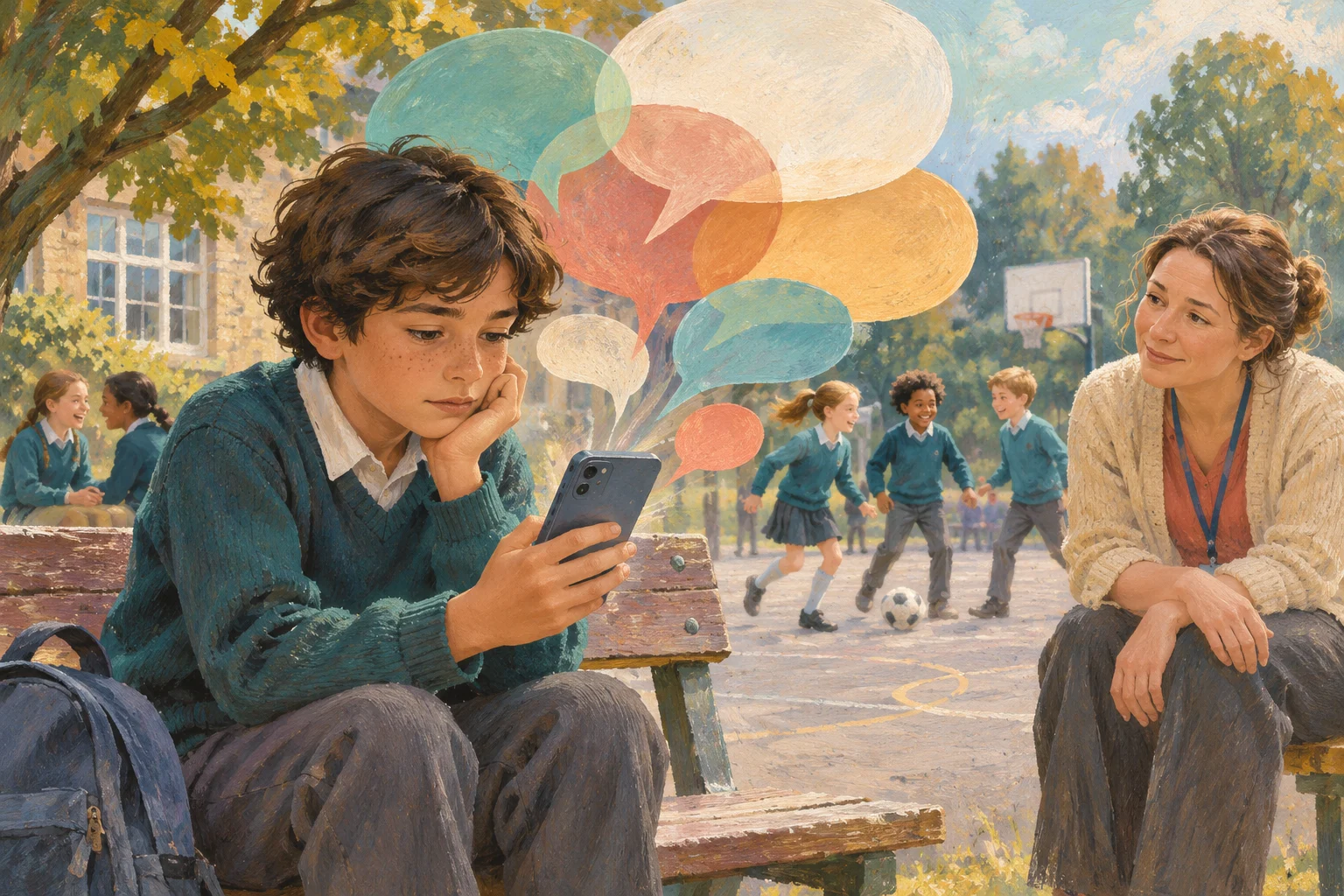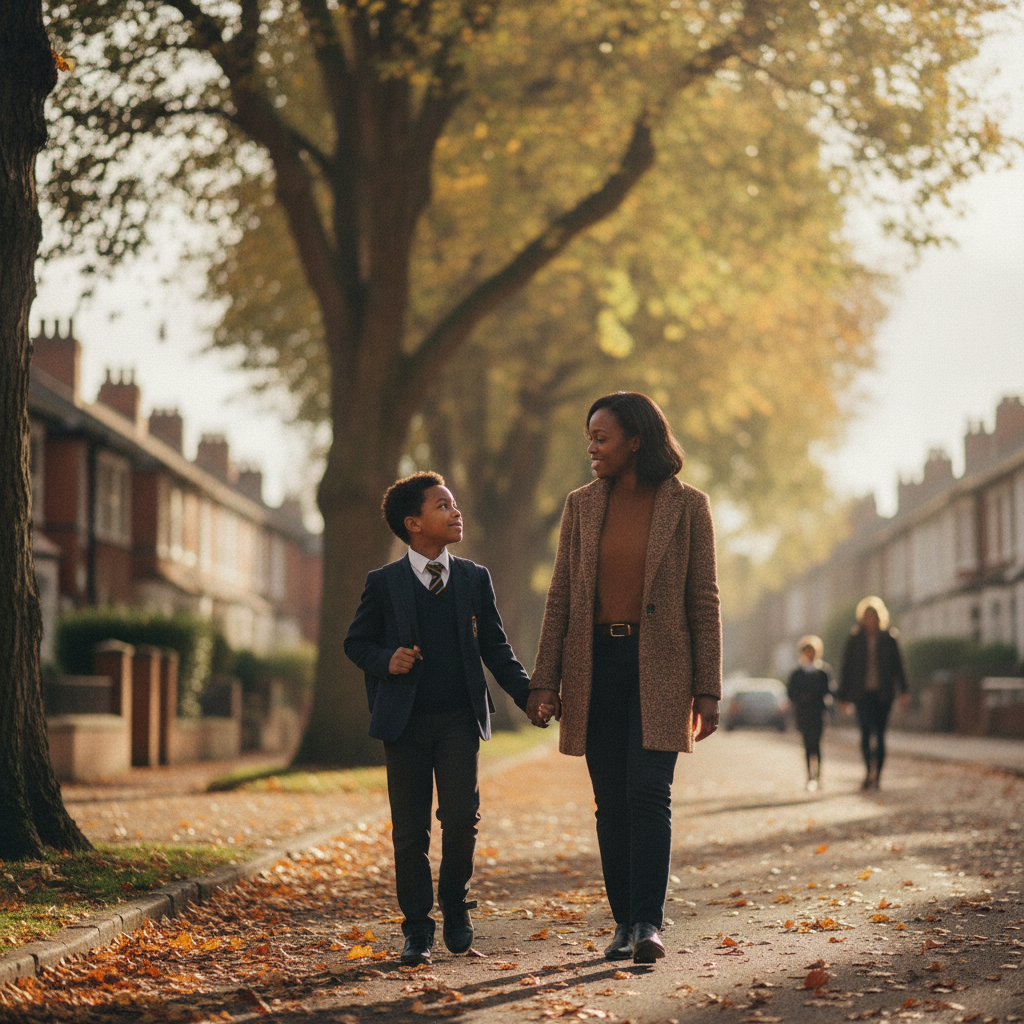
Why movement, teacher wellbeing and the emotional atmosphere of a classroom matter more than we might think.
Have you ever collected your child from school, asked how their day went, been told "fine", and then watched everything unravel the moment you got home?
The school bag gets dropped. A perfectly reasonable question is met with irritation. A sibling says the wrong thing. Homework becomes a battle. Suddenly, a child who has apparently managed an entire school day is crying over something seemingly insignificant.
And as parents, we find ourselves wondering: What on earth happened at school today?
We tend to look for explanations at home. Are they hungry? Overtired? Spending too much time on screens? Not getting enough sleep?
All of these things matter, of course.
But what if we're only looking at half the picture?
What if the emotional exhaustion our children bring home isn't simply about what's happening in our homes, but about the environments they're spending most of their waking hours in?
And what if the stress of the school day is quietly becoming the stress of family life?
The invisible emotional journey between school and home
Children don't leave their emotions at the classroom door.
They arrive at school carrying whatever happened that morning: perhaps a rushed breakfast, a disagreement with a sibling, a poor night's sleep or anxiety about something happening in their social world.
And they come home carrying their experiences from school.
For some children, that means excitement, confidence and a sense of achievement. For others, it can mean frustration, overstimulation, disappointment or the exhaustion of having held themselves together all day.
This is particularly important when we consider emotional regulation: the developing ability to understand and manage feelings, impulses and responses.
Children are still learning these skills. They rely on the adults around them, predictable routines, appropriate boundaries and environments that support their emotional development.
Yet when a child struggles to concentrate, becomes restless or appears irritable, we can be quick to interpret their behaviour as a discipline problem.
Perhaps we should be asking a different question.
Is this child being difficult, or is this child finding their environment difficult?
The distinction matters.
The school–home dysregulation loop
It's easy to imagine how a cycle might develop.
A child who hasn't slept well arrives at school already struggling to concentrate. The classroom is busy, noisy and demanding. They spend hours sitting still, perhaps with limited opportunities to move.
Their teacher is under pressure, the class becomes restless, and frustration begins to build.
By the time the child comes home, they've exhausted much of their emotional capacity.
The evening becomes tense. Homework takes longer. Family patience wears thin. Bedtime gets pushed back.
And the following morning, the same child arrives at school tired and emotionally unsettled once again.
It's a loop in which stress experienced in one environment can spill into the other.
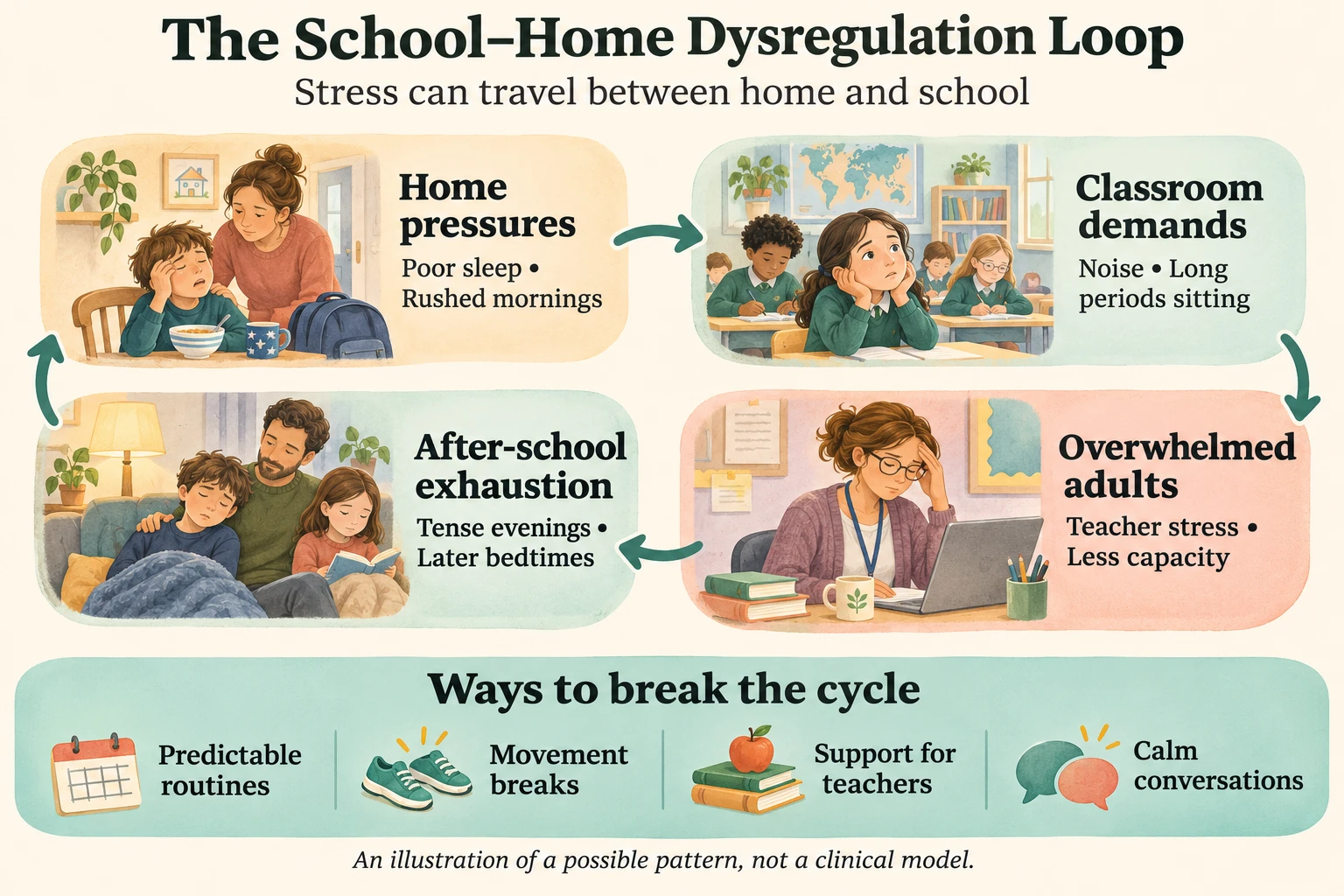
Of course, this isn't every child's experience. Nor is it a clinical model that explains all emotional difficulties.
But it illustrates why we need to stop thinking of home and school as two entirely separate worlds.
Children need to move. So why do we expect them to sit still for so long?
One of the things that concerns me most about modern education is how much we expect children to remain seated.
We know that children need physical activity. We know that movement supports physical health, wellbeing and healthy development.
Yet the structure of many school days still revolves around extended periods of sitting, listening and concentrating.
And when the weather is poor?
Playtime may be cancelled or moved indoors. Children who have already spent hours at their desks lose an important opportunity to run, jump, play and release some of that accumulated energy.
For children who particularly need movement to help them stay engaged, this can be challenging.
The science supports taking movement seriously.
According to the US Centers for Disease Control and Prevention, children aged 6–17 should participate in at least 60 minutes of moderate-to-vigorous physical activity every day.
A 2025 systematic review of 22 studies also suggested that short physical activity breaks during the school day can improve classroom behaviour, although the evidence for wider cognitive benefits was less conclusive.
More recent research published in 2026 found that classroom movement breaks may offer modest benefits for aspects of cognitive functioning, particularly working memory.
These studies don't suggest that movement will solve every behavioural or learning difficulty. But they do challenge the assumption that children must always be sitting quietly in order to learn.
Perhaps five minutes of stretching, moving or simply changing the classroom dynamic isn't time lost from education.
Perhaps it's an investment in the quality of the learning that follows.
And when outdoor play isn't possible, surely we can find better alternatives than expecting children to sit still for even longer?
When teachers are stressed, children notice
This is perhaps the most sensitive part of the conversation, but also one of the most important.
Teachers are human.
They experience stress, frustration, exhaustion and personal difficulties, just like the rest of us.
And teaching is an extraordinarily demanding profession.
According to the OECD's TALIS 2024 research, published in 2025, approximately half of teachers across participating education systems reported excessive administrative work as a source of stress.
Teachers are expected to manage increasingly diverse learning needs, meet curriculum expectations, maintain discipline, communicate with parents and support children's emotional development.
That's an enormous responsibility.
But there is something we need to acknowledge.
Children notice when the adults responsible for them are overwhelmed.
They notice changes in tone. They notice tension. They notice when a teacher seems unusually impatient, frustrated or emotionally exhausted.
Sometimes children even come home expressing concern for their teachers.
"She seems really stressed."
"He looks like he's having a hard time."
"Our teacher seems angry all the time."
Those observations shouldn't automatically be treated as evidence of poor teaching. Children can misinterpret adult emotions, and everyone has difficult days.
But neither should we dismiss them.
The emotional atmosphere of a classroom matters.
A child who regularly feels that an adult is frustrated, unpredictable or overwhelmed may spend more energy monitoring that environment and less energy concentrating on learning.
And that raises an important question:
Who is supporting the emotional wellbeing of the adults we expect to support our children's emotional wellbeing?
Teacher wellbeing cannot simply be another responsibility added to an already overwhelming workload.
Schools need to provide appropriate resources, manageable expectations, professional support and an environment where teachers can acknowledge difficulties and seek help.
Because protecting teacher wellbeing is also part of protecting children's learning environment.
Words matter more than we sometimes realise
We also need to think carefully about how adults communicate with children when they are frustrated.
There is a difference between setting firm expectations and using shame, comparison or fear to motivate a class.
Consider comments such as:
"My other class manages to do their homework. Why can't you?"
"How are you going to cope in secondary school if you can't even manage this?"
"You're the most difficult class I teach."
Adults may say these things in moments of frustration, hoping to encourage children to take greater responsibility.
But what do children actually hear?
They may hear that they are inadequate. That other children are better than them. That they are failing to meet expectations they don't fully understand.
For a child who is already anxious, struggling academically or finding friendships difficult, repeated negative comparisons may reinforce feelings of insecurity rather than motivate improvement.
Secondary school should be something children feel increasingly prepared for, not a looming threat used to frighten them into compliance.
Firm boundaries are essential. Accountability is important. Children need to learn resilience, responsibility and the consequences of their choices.
But discipline and emotional safety are not opposites.
A teacher can be authoritative without being intimidating. They can correct behaviour without humiliating a child. They can communicate disappointment without comparing pupils unfavourably with others.
And while it can be healthy for children to see adults acknowledge ordinary emotions and demonstrate how to manage them, pupils should not be expected to carry the emotional burdens of their teachers.
There is a difference between a teacher saying, "I'm feeling a little frustrated, so let's reset and try again," and repeatedly discussing personal trauma or adult problems with children who are not equipped to process them.
Children need adults who model emotional regulation, not adults who expect children to manage their emotions for them.
The responsibility doesn't stop at the school gates
Of course, it would be unfair to place all responsibility on teachers.
Children cannot be expected to arrive at school ready to learn if their basic physical and emotional needs are consistently overlooked at home.
As parents, we have a responsibility to create conditions that help our children function well.
That includes adequate sleep, nutritious meals, physical activity, reasonable boundaries around devices and predictable routines.
A child who has been awake late watching videos, skipped breakfast and rushed into school already feeling anxious may understandably struggle to concentrate.
We also need to be mindful of our own emotional regulation.
If mornings regularly involve shouting, rushing and frustration, children may carry some of that stress into the classroom.
And if they come home overwhelmed, our response can either help them settle or add another layer of tension.
This doesn't mean parents must be perfect. Far from it.
Sometimes the most helpful response to an after-school meltdown isn't an immediate lecture about behaviour or demands to finish homework.
It's food. A little quiet time. Some movement. Connection. Perhaps simply allowing a child to decompress before asking anything more of them.
But we also need to recognise that families have different resources, working patterns and circumstances. Not every parent can offer an ideal morning routine or an uninterrupted afternoon together.
That's precisely why partnership between schools and families matters.
Emotional safety is not the same as avoiding discomfort
There is an important distinction worth making.
An emotionally safe classroom isn't one where children never experience disappointment, frustration or challenge.
Learning can be difficult. Friendships can be complicated. Children need opportunities to make mistakes, overcome setbacks and develop resilience.
A good teacher cannot prevent every uncomfortable feeling, nor should they be expected to.
But an emotionally safe classroom should be one where children are treated with dignity, where expectations are clear and consistent, and where mistakes do not become a source of humiliation.
It should be somewhere children feel able to ask for help.
Somewhere they can admit they don't understand.
Somewhere they know that having a difficult day doesn't make them a difficult child.
And somewhere the adults recognise that emotional wellbeing and academic achievement are closely connected.
What should we be asking when choosing a school?
As parents, we often spend considerable time comparing examination results, facilities, extracurricular activities and school reputations.
But how often do we ask about the emotional experience of an ordinary school day?
How frequently do children get opportunities to move?
What happens during wet-weather breaks?
How does the school support pupils who become overwhelmed?
What training do teachers receive in emotional regulation and supportive behaviour management?
What support is available when a teacher is struggling?
How does the school communicate with families when a child is experiencing difficulties?
And perhaps most importantly:
How does the school know whether its pupils actually feel safe, respected and supported?
These questions tell us something that league tables and glossy brochures often cannot.
They tell us about the culture of a school.
Breaking the cycle starts with the adults
The answer isn't to blame parents for every difficult morning or teachers for every challenging afternoon.
It's to recognise that children's emotional wellbeing develops within a network of relationships and environments.
Parents can support their children through sleep, nutrition, movement, appropriate boundaries and a calmer home routine.
Teachers can support children by creating predictable classrooms, building movement into the day, setting respectful expectations and modelling healthy emotional responses.
And school leaders have a responsibility to ensure that teachers have the resources, professional support and working conditions needed to do their jobs well.
Because expecting exhausted teachers to regulate overwhelmed children without adequate support is neither fair nor sustainable.
There is no perfect parent, no perfect teacher and certainly no perfectly regulated child.
But there can be a shared commitment to doing better.
A final thought
When our children come home emotionally exhausted, we should resist the temptation to see their behaviour in isolation.
Sometimes the cause will be hunger or tiredness. Sometimes friendship difficulties. Sometimes frustration with schoolwork. And sometimes it may be an accumulation of pressures that neither the child nor the adults around them have fully recognised.
Not every after-school meltdown is a sign that something is wrong at school.
But repeated distress deserves curiosity, not dismissal.
As parents, we should be prepared to examine what we're contributing to our children's emotional environment at home.
And schools should be equally willing to examine the emotional environments they create during the day.
Because education isn't simply about how much information a child can absorb.
It's also about whether they feel sufficiently safe, supported and emotionally available to learn.
Perhaps we need to spend less time asking why children aren't behaving as we expect, and more time asking whether we're creating the conditions they need to thrive.
And perhaps a truly good school isn't just one that sends children home academically challenged.
It's one that sends them home feeling respected, supported and still emotionally intact.
Research and further reading
- OECD (2025) — Results from TALIS 2024: The State of Teaching. Research examining teacher workload, stress and professional wellbeing.
- Reyes-Amigo et al. (2025) — Effectiveness of school-based active breaks on classroom behavior, executive functions and physical fitness in children and adolescent: a systematic review. Frontiers in Public Health.
- Melguizo-Ibáñez et al. (2026) — Classroom Active Breaks as a Physical-Educational Intervention for Executive Functions and Mathematical Outcomes. Educational Psychology Review.
- US Centers for Disease Control and Prevention (2025) — Child Activity: An Overview.